
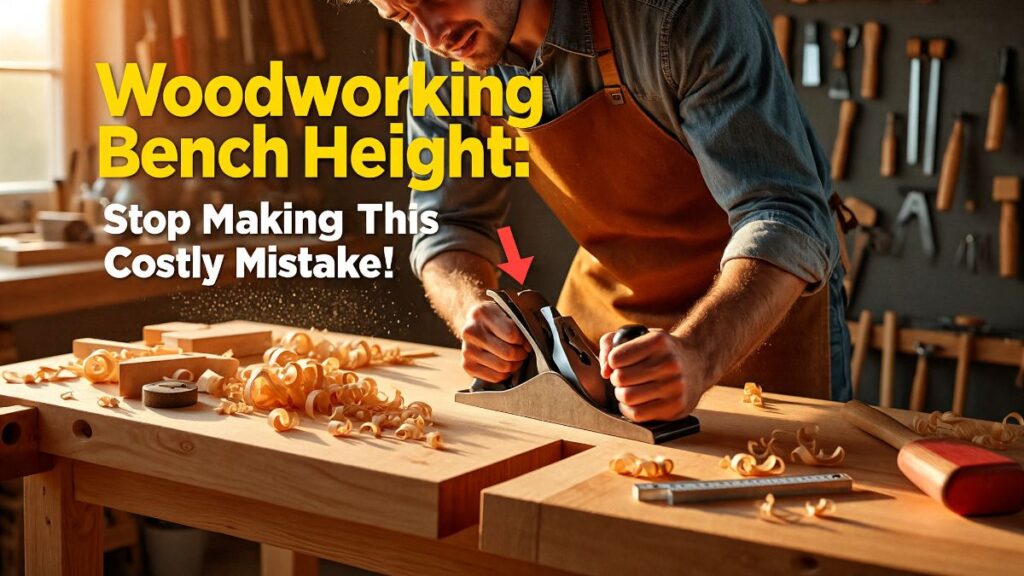

Okay so let me be very honest with you, when I first started woodworking in my small garage, I just copy pasted some random bench measurements from the internet and built my bench without thinking too much about it. Big mistake. After spending three weekend building that thing, my lower back started hurting after just one hour of sanding. I was confused, frustrated and almost gave up. Then one day my freind who does carpentry told me “yaar Udit, the woodworking bench height is the problem, not you.”
That one sentence changed everything for me.
So if you are a beginner who just started woodworking or if you are planning to build your first bench, please please read this full article. I promise you this will save a lot of pain, money and wasted wood.
What is Woodworking Bench Height and Why it Matters So Much
Okay so the woodworking bench height is basically how tall your work surface is from the floor. Simple right? But here is the confusing part… there is no single “one size fits all” number. This is what most beginners dont understand, including me when I started.
If your woodworking bench height is too low, you will hunch over like you are picking something up from the floor all day long. Your back will be finished. If the bench is too high, your shoulders and arms get tired super fast and you loose control of your tools.
The right woodworking bench height makes everything feel natural. You stand straight, your arms move comfortably and you can actually work for 2-3 hours without feeling like you ran a marathon.
And honestly for beginners this is even more important because we are still learning, so our body should not be fighting the bench. The bench should be helping us, not hurting us.
The Simplest Woodworking Bench Height Calculator You Will Ever See
Most articles online give you complicated formulas and I just dont get them sometimes. So let me explain the easiest way I use, which is basically a human body measurement method.
Here is what you do. Stand straight on the floor, wearing the shoes you normally wear in your workshop. Let both arms hang down naturally by your sides. Now ask someone to measure from the floor to where your wrist bone is, the little bump on the side of your wrist.
That number, that is your starting point for woodworking bench height.
For most people this comes between 32 to 36 inches. But wait, it also depends on what type of work you are doing. So let me break it down simply.
For hand tool woodworking like chiseling, hand planing, using hand saws, you want your woodworking bench height to be a little on the lower side. Why? Because you need to put your body weight behind the tool. If the bench is at wrist level or slightly below it, you can lean forward and push down with more force. No struggling needed.
For power tool woodworking like using a drill, orbital sander, router, a slightly higher bench is better. You need to see what you are doing clearly, so a little higher gives you better vision and control.
For detailed fine work like carving, inlay work, joinery, you actually want the bench higher, close to elbow height. This keeps your eyes closer to the work. Think of it like reading a book, you dont hold it on the floor, you bring it up towards your eyes.
So woodworking bench height is not just one number. It depends on your body AND your work type. Both things matter together.
Woodworking Bench Height Chart by Person Height (Simple Version)
Okay this is the part that I really wish somebody had made for me when I was starting. Here is a easy woodworking bench height chart. These are approx numbers, not exact science, but they are a very solid starting point.
Your Height and Suggested Woodworking Bench Height:
| Your Height | General Purpose Bench | Hand Tool Work | Power Tool Work |
|---|---|---|---|
| 5’4″ to 5’6″ | 32 to 33 inches | 30 to 31 inches | 33 to 34 inches |
| 5’7″ to 5’8″ | 33 to 34 inches | 31 to 32 inches | 34 to 35 inches |
| 5’9″ to 5’10” | 34 to 35 inches | 32 to 33 inches | 35 to 36 inches |
| 5’11” | 35 to 36 inches | 33 to 34 inches | 36 to 37 inches |
| 6’0″ | 35 to 37 inches | 33 to 35 inches | 37 to 38 inches |
| 6’2″ | 37 to 38 inches | 35 to 36 inches | 38 to 39 inches |
| 6’4″ and above | 38 to 40 inches | 36 to 38 inches | 40 to 42 inches |
Now these numbers are not stone written rules, okay? They are a guide. If you try 35 inches and it feels slightly wrong, adjust by one inch and try again. The woodworking bench height is something you will fine tune over time.
One quick thing to also know about the workbench height for 5 10 people specifically, most woodworkers that height find 34 to 36 inches very comfortable for general use. And workbench height for 6 0 usually falls between 35 to 37 inches for mixed use. For workbench height for 5 7 people, something around 33 to 34 inches works nicely for most tasks.
For workbench height for 5 11 and workbench height for 6 2, you will notice the chart shows slightly more room upward, because taller folks need that extra clearance to avoid hunching. Always test before committing!
My Personal Story of Getting the Woodworking Bench Height Wrong
Okay, I’m just going to say this because maybe it will help you not do the same dumb thing I did.
So I am around 5 feet 10 inches tall. When I built my first bench, I just googled “standard workbench height” and some website said 34 inches. I built it at exactly 34 inches.
For the first few days it felt okay. But then I started a big hand planing project and by the second hour my lower back was on fire. I thought I was just “not fit enough” for woodworking. I almost believed that for like three weeks.
Then I put some 2×4 blocks under my bench legs temporarily, raised it to 36 inches, tried again. Instant improvement. I could feel my body was not fighting the work anymore.
Now for my current bench I actually went with 35 to 36 inches and it feels very natural for my mixed use work. Hand tools, power tools, assembly, everything works at this woodworking bench height for me personally.
The point is, dont be shy to experiment. Woodworking bench height is not permanent if you plan ahead. I will tell you how to do that in budget friendly way next.
Budget Friendly Ways to Adjust Your Woodworking Bench Height (No Need to Rebuild!)
This section is something I did not see on any competitor website and I think is super useful for beginners on a tight budget. So listen up.
Option 1: Scrap Wood Blocks Under Legs
The most cheap and easy way. Just cut 4 pieces of thick scrap wood (2×4 or 4×4 depending on how much height you need) and place them under each leg of your bench. Secure them with screws or just leave them stable if your bench is heavy. This gives you 1.5 to 3.5 extra inches easily. Cost? Almost zero if you have scrap wood.
Option 2: Adjustable Feet (Leveling Feet)
You can buy adjustable furniture leveling feet online for very cheap, like 5 to 10 dollars for a set of four. Screw them onto the bottom of your bench legs and you can raise or lower the bench height by up to 2 inches anytime you want. This is brilliant for beginners who are still figuring out their perfect woodworking bench height.
Option 3: Anti Fatigue Mat for Standing
Wait, this is a interesting trick. If your bench is 1 inch too high but you dont want to cut the legs, just use a 3/4 inch thick anti fatigue mat to stand on. Now your effective standing height increased by 3/4 inch, so it feels like the bench came down. Works backwards but it really does work.
Option 4: Build Longer Legs From Start
If you are building your bench fresh, here is my biggest tip. Make the legs 2 to 3 inches taller than you think you need. It is so much easier to cut legs shorter later than to add height later. I wish someone told me this on day one.
If you are on a tight budget and just starting out, I recommend you also read this guide on how to start woodworking with low budget in 2026 which covers a lot of beginner money saving tips I personally follow. And if you want to explore more beginner friendly woodworking content, Popular Woodworking is honestly one of the most trusted places online where you can find tips, tool reviews and project plans completely suited for someone just starting their woodworking journey.
Workbench Height for Sitting vs Standing Work
Okay another thing most people dont think about. Are you going to stand at your bench always? Or sometimes sit?
For standing woodworking bench height, all the numbers in the chart above apply. But for sitting work, the height is very different.
If you want to sit on a stool or chair, the woodworking bench height should be around 28 to 30 inches for most people. This lets you put your feet flat on the floor and keep your forearms resting comfortable on the bench surface.
Some advanced woodworkers actually build two benches, one at standing height and one at sitting height. But for beginners, that is too much investment. Just start with one good standing height bench and get a adjustable height stool if you need to sit sometimes.
Common Woodworking Bench Height Mistakes Beginners Make
Let me quickly talk about some mistakes I see beginners make, including me haha.
Mistake 1: Using Standard Numbers Without Measuring Yourself
Every woodworking guide says “the standard workbench height is 34 to 36 inches.” So beginners just pick 34 or 36 without ever measuring their own body. Please dont do this. The woodworking bench height that works for you is based on YOUR body, not some average person on the internet.
Mistake 2: Not Thinking About Shoe Height
This one is silly but real. The woodworking bench height should be measured and tested while wearing the shoes you actually wear in your workshop. If you wear thick soled boots, you are standing 1 to 1.5 inches taller than barefoot. That matters.
Mistake 3: Forgetting the Thickness of Workpieces
When you put a thick board on your bench and start working on it, the effective height increases. So if you are mostly doing hand planing on thick lumber, your woodworking bench height should account for this. Maybe go 1 to 2 inches lower than your wrist measurement.
Mistake 4: Making It Impossible to Change
Building a workbench with legs that cannot be shortened or extended is a trap. Always design for adjustability, especially as a beginner. Your perfect woodworking bench height might change as you try different projects.
If you are building your first woodworking bench and want some project ideas to try on it, check out these free DIY woodworking projects for beginners to get some inspiration on what to make first.
How the Type of Work Changes Your Ideal Woodworking Bench Height
This is something I find fascinating honestly. Let me explain with simple examples.
Hand Planing: You need more downward body weight. So woodworking bench height should be lower, around knuckle to wrist level. This lets you lean your whole upper body into the plane stroke.
Chiseling: Medium height works best. You want your eyes above the work but your arms should not be raised too high. Elbow level or just slightly below is good.
Sanding: Higher bench is better because sanding is often slow, detailed work. You want to see what you are doing clearly. Closer to elbow height feels natural.
Sawing: A slightly lower bench gives you better control when pushing and pulling the saw. Your arm movement is more natural.
Assembly / Gluing: This is where the workbench height matters in a different way. When you are assembling big pieces, a lower bench gives you more working room because the assembled piece gets tall. Many beginners dont think about this.
The truth is, the “perfect” woodworking bench height for one task is never perfect for all tasks. That is why I always say plan for the task you do most, then compromise for the rest.
According to experienced woodworkers, a good general rule is that a lower bench works well for heavy physical work while a taller surface helps when detail and precision are needed. This matches exactly what I discovered by trial and error.
How to Test Your Woodworking Bench Height Before Building
This is my favourite tip and it is totally free.
Before you build anything, just test different heights using temporary setups. Stack some books or plywood pieces on your kitchen counter or dining table to simulate different bench heights. Then pretend to sand, plane, and chisel at each height for a few minutes.
Your body will literally tell you which height feels right. You will feel it in your shoulders, your back, your wrists. This 20 minute test can save you from weeks of discomfort.
I actually recommend everyone do this before committing to any woodworking bench height. It sounds silly but it is honestly the best woodworking bench height calculator that exists. Your own body is the most accurate tool you have.
Woodworking Bench Height Quick Reference and Final Tips
Alright, let me wrap this up nicely for you. Here is my simple summary of everything we covered about woodworking bench height.
First, measure from floor to your wrist bone while standing normally. That is your baseline woodworking bench height.
Second, adjust up or down by 1 to 2 inches based on what you mostly do. Hand tools = slightly lower. Power tools and detail work = slightly higher.
Third, if you are between 5’9″ and 5’10”, aim for 34 to 36 inch woodworking bench height as your starting range. For those at 5’11” or 6’0″, go between 35 to 37 inches. For taller folks at 6’2″ and above, 37 to 40 inches is your zone.
Fourth, always build bench legs a bit taller than needed. Cut them down later if required. Never regret going too short.
Fifth, test before you build. Stack stuff up, simulate the work, feel it in your body.
The woodworking bench height you end up with will probably not be “perfect” the first time. And that is completely okay. Woodworking is a journey, you keep learning and adjusting. Even after years, I still fine tune my setup when I start a new type of project.
One last thing, dont spend a lot of money chasing the perfect woodworking bench height solution. Some scrap wood under the legs works just as good as expensive adjustable hardware sometimes. Keep it simple, keep it budget friendly, and focus on building things.
FAQs About Woodworking Bench Height
What is the standard woodworking bench height for most people?
Most people find 34 to 36 inches comfortable for general woodworking, but it really depends on your own body height and the type of tasks you do most.
How do I calculate the right woodworking bench height for my body?
Stand straight with shoes on and measure from floor to your wrist bone. That number is usually a great starting point for your personal woodworking bench height.
Is workbench height for 6 0 different from workbench height for 5 10?
Yes, a person who is 6’0″ usually needs about 35 to 37 inches while someone at 5’10” works comfortably at around 34 to 36 inches, though both should test and adjust personally.
Can I fix my workbench if the woodworking bench height is wrong?
Absolutely yes. You can add scrap wood blocks under legs to raise height, or cut the legs shorter to lower it. Adjustable leveling feet are also a cheap and easy solution.