
Ok so let me be honest with you guys. When I first tryed to make a woodworking nightstand at my home, I totally messed it up. Like the drawer was not closing properly, the legs were wobbly and my wife looked at me like I wasted our weekend for nothing. But you know what, I did not give up. I kept trying and now I am writing this whole guide for you so you dont make the same silly mistakes I did. If you are a complete beginner and you want to build a beautiful bedside table without spending too much money, this post is for you.
My name is Udit Das and I run this small blog called easydiywood.com where I share all my woodworking adventures and sometimes my woodworking disasters also haha. I am from India originally but now I help people all around USA and other countrys to make cool stuff from wood at home.
Why You Should Build Your Own Woodworking Nightstand
So here is the thing. Have you ever gone to a furniture store and seen a nice looking nightstand? And then you check the price tag and its like $300, $500 or even more? I was shocked when I first started looking. Some bedside tables at popular stores cost more than $1000 if you can beleive that.
But guess what, you can build your own woodworking nightstand for under $50 to $75 if you pick the right wood and use basic tools. That is what I did and it came out looking really really nice. My freind came over and he thought I bought it from some fancy store.
The best part about making your own nightstand is that you can make it the exact size you want. Maybe your bed is taller or shorter than normal. Maybe you want more storage or less storage. When you build it yourself you have full control.
And honestly speaking, there is something special about sleeping next to a piece of furniture that your own hands created. Its like a small victory every night before you sleep.
What Wood Should You Pick for a Budget Woodworking Nightstand
Ok so this is where most beginners get confused. There are so many types of wood out there and you dont know which one to use right?
Let me make it simple for you. If you want to save money, go with pine. Pine is cheap, easy to cut, easy to sand and you can find it at pretty much any hardware store like Home Depot or Lowes. A standard pine board wont cost you much and its soft enough that even basic tools can handle it without problems.
Now if you want something a little more stronger and still not too expensive, go with poplar. I have written a whole guide on poplar woodworking for beginners on my blog if you want to check that out. Poplar is nice because it takes stain well and its harder than pine but still soft enough for beginners to work with.
Another option which I personally love is plywood. Yes I know some people say plywood is not real wood but hear me out. Good quality plywood like birch plywood looks great, its stable, it dont warp easily and its perfect for making a woodworking nightstand with drawers because the panels stay flat.
If you are looking at woodworking nightstand plans pdf then most of them suggest using 3/4 inch plywood for the main body and 2×2 lumber for the legs. This combo is super cheap and works realy well.
Tools You Will Need for This Woodworking Nightstand Project
Alright so dont panic when you see tool lists on other websites. Some of them list like 20 different tools and it feels like you need a whole workshop. You dont need all that. Let me tell you what you actually need for this beginner woodworking nightstand build.
Basic tools that are must have:
Measuring tape, pencil, a square for marking straight lines. These are non negotiable ok.
A drill. You can use a cordless drill and honestly this is the one tool you should invest in if you dont have it already. You will use it for everything.
A saw. Now ideally a miter saw is best for clean cuts. But if you dont have one, a circular saw works fine. Even a hand saw can do the job, it will just take more time and your arm will get tired haha.
Pocket hole jig. This is optional but I highly recomend it. A Kreg Jig makes joining two pieces of wood so easy. Its like cheating almost. You drill angled holes and screw the pieces together and it makes super strong joints without showing any screws from outside.
Sandpaper. Get some 120 grit and 220 grit. Sanding is boring I know but it makes your woodworking nightstand look proffesional.
Clamps. At least 2 or 3 bar clamps. Trust me you will need extra hands and clamps are those extra hands.
If you are just getting started with woodworking tools, I have a detailed guide about woodwork machines for beginners that might help you understand what to buy first.
Woodworking Nightstand Plans Free: My Simple Design
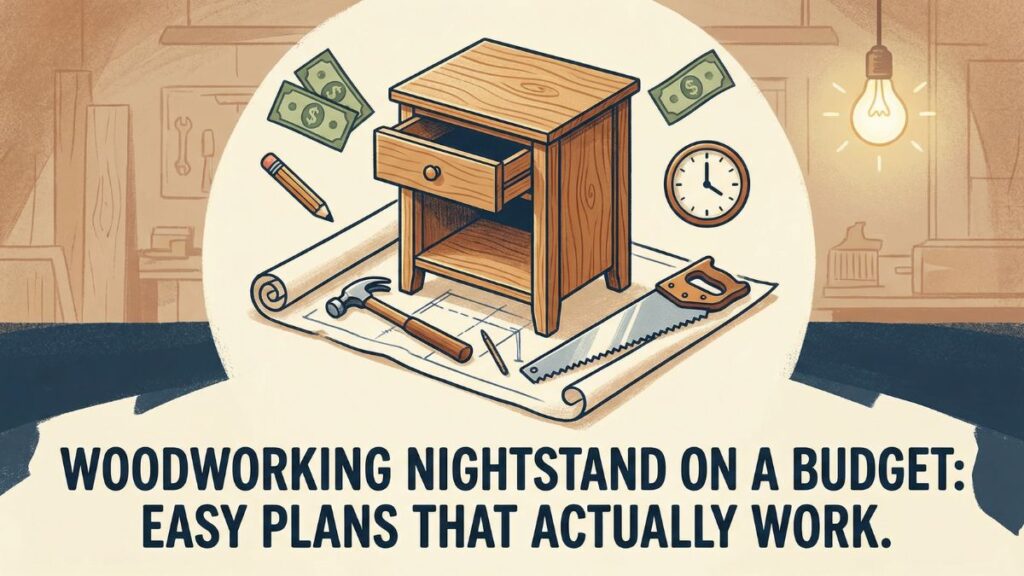
Ok so now comes the fun part. Let me share with you the simple woodworking nightstand plans that I use for my builds. This design has one drawer on top and an open shelf below. Its perfect for keeping your phone, a book, maybe a glass of water and hiding small things in the drawer.
Dimensions of the nightstand:
Height: 25 inches (you can adjust this based on your mattress height, the general rule is it should be close to the top of your mattress or maybe 1 to 2 inches above)
Width: 20 inches
Depth: 16 inches
These measurements work for most beds. But remember the beauty of a DIY woodworking nightstand is that you can change these numbers to fit your space.
Cut list for one nightstand:
4 legs from 2×2 lumber, cut to 24 inches each
2 side panels from 3/4 inch plywood, cut to 14.5 inches by 16 inches
1 bottom shelf from 3/4 inch plywood, cut to 17.5 inches by 14.5 inches
1 top piece from 3/4 inch plywood or pine panel board, cut to 20 inches by 16 inches
Drawer box pieces from 1×4 boards and 1/4 inch plywood for drawer bottom
1 pair of 12 inch or 14 inch drawer slides
I know this looks like a lot of pieces but trust me once you start cutting it goes pretty fast. I usually finish all my cuts in about 30 to 40 minutes.
How to Build a Nightstand with a Drawer: Step by Step
Ok friends here we go. This is the actual building part and I am going to walk you through each step just like I would if you were standing next to me in my workshop.
Step 1: Cut all your wood pieces first
Before you start joining anything, cut every single piece according to the cut list above. Double check your measurements please. I cannot tell you how many times I have cut a piece wrong because I was in a hurry. Measure twice cut once, this old saying exists for a reason.
Step 2: Build the side frames
Take two 2×2 legs and one side panel. Drill pocket holes along the edges of the plywood panel. Now attach the panel to the legs using pocket hole screws and wood glue. The plywood should be flush with the inside edge of the legs.
Do this for both sides. Now you have two side assemblies that look like a letter U turned upside down basically.
Step 3: Connect the sides together
Now take your bottom shelf piece and drill pocket holes on its edges. Position it between the two side frames at the bottom area, maybe about 3 to 4 inches from the floor. Screw it in with pocket hole screws and wood glue.
This is where your woodworking nightstand starts to actually look like furniture and not just random pieces of wood. Its exciting honestly.
Step 4: Add a support piece for the drawer
Cut a 1×3 board to fit between the two sides at the top area. This piece will support the drawer section. Attach it with pocket holes and screws. Make sure its level otherwise your drawer will be all crooked and it will look weird.
Step 5: Install the drawer slides
This part scared me the most when I first did it. Installing drawer slides sounds complicated but its really not. You basically screw one part of the slide to the inside of the nightstand body and the other part to the drawer box.
Most 12 inch or 14 inch ball bearing drawer slides come with instructions in the box. Follow them carefully. The important thing is to make sure both slides are at the exact same height on both sides. If one is even a tiny bit off, the drawer will not open smoothly.
Step 6: Build the drawer box
For the drawer, cut your 1×4 pieces to make a box. The width of your drawer box should be about 1 inch less than the opening to allow for the drawer slides on each side. Most slides need about half inch clearance on each side.
Attach the sides using wood glue and brad nails or pocket holes. Then add the 1/4 inch plywood bottom. You can just glue and staple it to the bottom of the box.
If you want to learn more about how to build a nightstand with a drawer, the key thing is taking your time with measurements. Drawers need to be precise. Even small mistakes show up quickly.
Step 7: Attach the top
Flip the whole nightstand upside down. Place the top piece on it, center it nicely with equal overhang on all sides. Screw it from inside through the legs and side frames into the top using 1 1/4 inch screws.
Step 8: Add the drawer front
Cut a piece of wood that is slightly bigger than the drawer opening. This becomes your drawer face that everyone will see. Attach it to the front of the drawer box from inside using screws and a little bit of wood glue.
Add a knob or pull and you are done with the building part of your woodworking nightstand.
Finishing Your Woodworking Nightstand: Stain or Paint
Now your nightstand is built but it probaly looks a bit rough right? This is where finishing comes in and honestly this step makes the biggest difference.
First sand everything. Start with 120 grit sandpaper and go over every surface. Then switch to 220 grit for a smooth finish. Wipe off all the dust with a damp cloth after sanding.
For staining, I like to use Minwax stains. Special Walnut and Early American are two of my favorite colours for a woodworking nightstand. They give a warm look that goes with almost any bedroom.
If you prefer painting thats cool too. A nice white or grey paint can make your nightstand look very modern and clean. Just make sure to use a primer first if you are painting over pine because pine can get blotchy without primer.
After stain or paint has dried, apply 2 to 3 coats of polyurethane. This protects your nightstand from water rings and scratches. Satin finish poly looks most natural and not too shiny. This is specially important for nightstands because people always keep water glasses on them and you dont want water damage after all that hard work.
How to Build a Nightstand with 2 Drawers
Now some of you might be thinking one drawer is not enough. Maybe you have lots of things you want to hide away. Dont worry, you can easily modify this same woodworking nightstand plan to add a second drawer.
The trick is simple. Instead of having one drawer section and one open shelf, you divide the space into two drawer sections. You will need one extra set of drawer slides and one extra support piece between the two drawers.
Make the nightstand a little bit taller, maybe 28 inches instead of 25 inches. This gives enough room for both drawers to be a good usable size.
When you are looking at bedside table plans PDF or woodworking nightstand plans free, look for ones that show the spacing between drawers clearly. You want at least 6 to 7 inches of height for each drawer opening so your stuff can actually fit inside.
Building a woodworking nightstand with drawers (two drawers) is a little more challanging than a single drawer version. But if you already built one drawer succesfully, the second one is just repeating the same process. You already know how the slides work and how the box is made.
My Mistakes and What I Learnt (So You Dont Have To)
Ok so I promised to be honest in this post so here are some of my real mistakes from when I was building my first woodworking nightstand. Please learn from my silliness.
Mistake 1: I did not check if my nightstand was square before installing the drawer. The whole thing was slightly twisted and the drawer was jamming every time I tried to open it. Always use a square or measure diagonally to check.
Mistake 2: I used cheap drawer slides from a dollar store. They broke within like 2 weeks. Spend a little extra on decent ball bearing drawer slides. They make such a huge differencee in how smooth the drawer operates.
Mistake 3: I skipped sanding before staining. The stain went on all patchy and looked terrible. I had to sand the whole thing again and redo it. Dont skip sanding friends, just dont.
Mistake 4: I made my nightstand way too tall. It was like 32 inches and my bed was pretty low. So the nightstand was towering over the mattress and looked really odd. Measure your mattress height first then decide the nightstand height.
Budget Breakdown for This Woodworking Nightstand
Let me give you an honest budget breakdown so you know exactly what you are getting into. These prices are based on what I found at Home Depot and Lowes in the USA.
2×2 lumber (8 foot board, you need 1): around $3 to $5
3/4 inch plywood (quarter sheet): around $15 to $20
1×4 boards for drawer: around $5 to $8
1/4 inch plywood for drawer bottom: around $5
Drawer slides (one pair): around $8 to $12
Pocket hole screws: around $5 for a box
Wood glue: around $4
Stain or paint: around $8 to $12
Polyurethane: around $8
Drawer knob or pull: around $3 to $5
Total cost: roughly $60 to $80 for one woodworking nightstand
If you already have some basic tools and leftover wood from previous projects, you can bring this cost down even more. I have made nightstands for as cheap as $35 when I had spare plywood lying around.
Compare that to buying a similiar looking nightstand from a furniture store which would cost you anywhere from $150 to $500 or even more. The savings are huge and you get the pride of saying you built it yourself.
Free DIY Nightstand Plans PDF: Where to Find Them
If you want more detailed woodworking nightstand plans with exact diagrams and visual cut lists, there are some great resources out there. One of my favorites is Ana White’s nightstand plans collection where you can find tons of free designs ranging from farmhouse style to modern minimalist. Her plans come with shopping lists, cut lists and step by step pictures which is super helpful for beginners.
Another amazing resource is Kreg Tool’s free nightstand project plans where they have over 30 different nightstand designs you can download and build. Their plans are really well organized and they show you exactly where to drill pocket holes, wich is a big help when you are just starting out.
You can also find woodworking nightstand plans pdf on YouTube descriptions. Many woodworkers share their PDF plans for free when you watch their build videos.
My suggestion is to start with a simple one drawer design first. Get comfortable with that build. Then move on to more complex woodworking nightstand plans that include two drawers or fancy details.
The key to finding good free DIY nightstand plans PDF free download is to look for ones that clearly list all the dimensions, have a cut list and show pocket hole locations. Bad plans leave out these details and then you are stuck guessing, wich is not fun when you already spent money on wood.
Design Ideas for Your Woodworking Nightstand
Lets talk about making your woodworking nightstand look cool and unique. Because building it is one thing but making it look beautiful is another.
Rustic farmhouse look: Use rough pine boards and stain them in a dark walnut colour. Add some vintage style knobs from a thrift store. This look is very popular right now and it hides small mistakes in your woodwork because the rustic style is supposed to look a little imperfect.
Modern and clean: Use birch plywood and leave it natural or apply a light oil finish. Add simple modern pulls or leather tab handles. Keep the lines straight and the design minimal.
Two tone style: Paint the body of your woodworking nightstand in white or grey and keep the drawer front and top in natural wood stain. This contrast looks really nice and gives a custom expensive vibe.
Kids room nightstand: Make it shorter, maybe 18 to 20 inches tall. Add bright colours and fun knobs shaped like animals or stars. A woodworking nightstand for a kids room is a great beginner project because it does not have to be perfect, kids dont care about small gaps haha.
If you have built other furniture before like a woodworking dining table on a budget, then this nightstand project will feel even easier for you because many of the same skills apply.
Tips for Making Your Woodworking Nightstand Last Long
So you put in all this effort to build a beautiful nightstand. You dont want it falling apart in 6 months right? Here are my tips for making your woodworking nightstand durable and long lasting.
Always use wood glue along with screws. Screws alone can loosen over time but glue creates a permanent bond. Together they make joints super strong.
Apply polyurethane or some kind of sealer on top. Raw wood absorbs moisture and can get damaged. A good sealer protects against water stains and everyday wear.
Dont place your nightstand right next to a heating vent or in direct sunlight. Heat and sun can cause wood to dry out and crack over time. A little bit of care goes a long way.
Tighten the drawer slides and screws after a few weeks of use. Things settle and sometimes screws need a quarter turn to stay snug.
If your nightstand feels wobbly, add small felt pads under the legs to level it out. This also protects your floor from scratches.
Woodworking Nightstand: My Final Thoughts
So there you have it friends. A complete guide on how to build a woodworking nightstand on a budget that looks great and works perfectly. I hope this post helped you feel more confident about taking on this project.
Building a woodworking nightstand is one of the best beginner projects because its small enough to finish in a weekend, its useful, its cheap to make and it looks impressive when its done. Every time someone sees your handmade nightstand they will be surprised you built it yourself.
If I can do it, you can definately do it too. I started with zero experience and now I have built more nightstands than I can count. Some for my home, some for freinds and some just for practice.
So go grab some wood, get your tools ready and start building your own woodworking nightstand this weekend. You wont regret it, I promise.
Happy building everyone!
FAQ
How much does it cost to build a DIY nightstand?
You can build a basic woodworking nightstand for about $50 to $80 depending on the wood and hardware you choose. Using leftover wood can bring the cost under $40.
What is the best wood for a beginner nightstand project?
Pine and poplar are the best choices for beginners because they are cheap, easy to cut and easy to sand. Plywood also works great for panels and shelves.
How tall should a nightstand be?
The standard nightstand height is between 24 to 28 inches. Ideally it should be close to the top of your mattress or about 1 to 2 inches higher for comfortable reach.
Can I build a nightstand without a pocket hole jig?
Yes you can use wood glue with brad nails or regular screws. A pocket hole jig makes things easier but its not a must have. Many people build great nightstands with just basic tools.