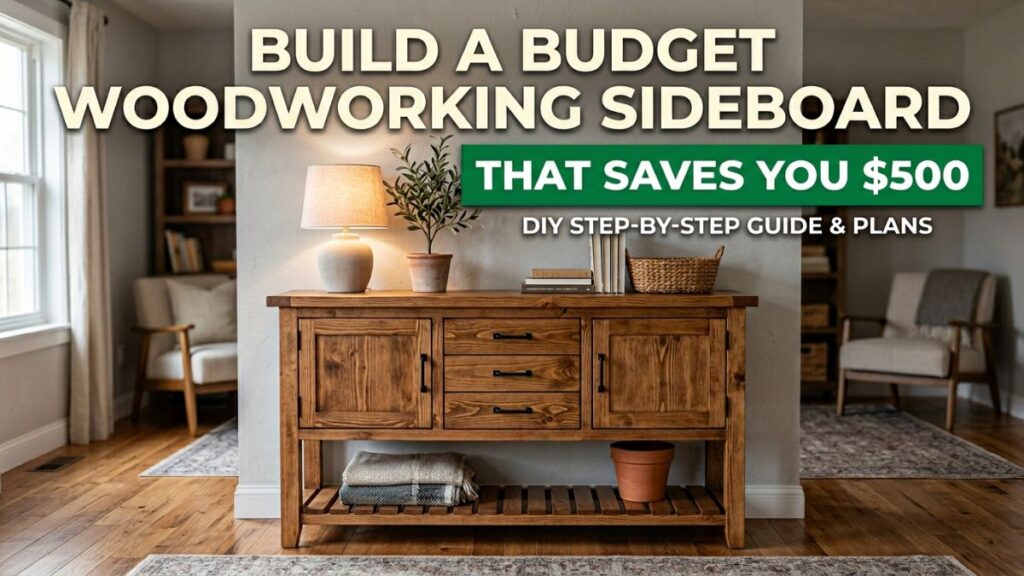

Okay so let me be honest with you. When I first started thinking about building my own woodworking sideboard, I was kind of nervous. Like really nervous. I had no idea what wood to buy, what tools I needed, and I definitely did not want to waste money on something that would fall apart in a week. Sound familiar?
I am Udit Das and I run easydiywood.com. I do woodworking as a hobby, mostly small stuff at first. But one day I just decided okay lets try this sideboard thing. And man, I am so glad I did. Because building a woodworking sideboard yourself saves you so much money compared to buying one from a shop. We are talking like $400 to $600 saved on one single piece of furniture. No joke.
This guide is for complete beginners. If you have never built anything before, this is the right place to start.
What Exactly Is a Woodworking Sideboard Anyway
Before we start cutting anything, lets just talk a little bit about what a sideboard even is. Because not everyone knows this word right away.
A sideboard is basically a long low storage cabinet. You put it in your dining room, living room, sometimes even the hallway. It has doors, sometimes drawers too. You can keep dishes, extra stuff, anything really inside it. Some people call it a buffet cabinet too and yeah they are pretty much the same thing.
Fancy stores sell them for crazy prices. Like $800, $1200, even $2000 sometimes. But a DIY woodworking sideboard made at home? You can build one for around $80 to $150 depending on what wood you use and how big you want to make it. That is the honest truth from someone who has actually done it.
Why DIY Sideboard Is Better Than Buying From IKEA
Okay here is something not many blog posts will tell you clearly. Yes you can find woodworking sideboard ikea options and they look okay. They are cheap. Fine. But there are some big problems.
IKEA sideboards are made from particle board mostly. That stuff does not last more than a few years if you use it heavily. Screws start coming loose, edges start chipping. And honestly? You can not really customize the size or color the way you want.
When you build your own woodworking sideboard cabinet from real plywood or pine boards, it is so much stronger. And you get to decide exactly how wide, how tall, how many shelves, how many drawers. Complete control.
Also there is this feeling when you look at something in your house and think “I made that.” That feeling is worth something. Trust me.
What Wood Should You Use for Your Sideboard Cabinet
This is where many beginners get confused. Walk into Home Depot and there are like 50 types of wood staring at you. So let me simplify this.
For a budget woodworking sideboard, I always suggest these two options:
3/4 inch plywood is the most common choice. Birch plywood or even regular sanded plywood works great. It is strong, does not bend easily, and you can stain it or paint it however you like. One full 4×8 sheet costs around $40 to $55.
Pine boards are another good option. They are softer wood so easier to work with as a beginner. A solid wood buffet with drawers built from pine boards looks really good when finished nicely. Pine is cheap and very easy to find.
Now some people ask about oak or walnut for a woodworking sideboard buffet cabinet. Those are beautiful but more expensive. For your first build, stick with plywood or pine. Save the fancy wood for later when you have more confidence.
If you want to know more about different wood types for DIY projects, check out my guide on poplar woodworking for beginners which covers a lot of the beginner friendly wood choices in detail.
Tools You Actually Need (Nothing Fancy)
Here is the good news. You do not need a full workshop to build a woodworking sideboard. Seriously.
The basic tools you need are these. A circular saw or miter saw for cutting. A drill for making holes and putting screws in. A Kreg Jig or pocket hole jig for joining pieces together. Sandpaper or a random orbital sander. A measuring tape. Some clamps to hold things while glue dries.
That is honestly it for a basic sideboard cabinet build. The Kreg Jig is the one tool I really recommend investing in if you dont have one. It makes joining wood pieces so much easier and the joints come out really clean. A basic Kreg Jig starter kit runs about $25 to $35.
I have a full post on woodworking machines for beginners on a budget if you want a deeper look at what tools are worth buying when you are just starting out.
Simple Woodworking Sideboard Plans for Beginners
Now lets talk about actually building this thing. I am going to give you a simple approach that works well for a beginner. This is not complicated okay.
For a starter woodworking sideboard, I suggest making one that is about 48 inches wide, 32 inches tall, and 15 inches deep. That size fits most dining rooms and does not require too much wood.
Materials list for a basic build:
Two sheets of 3/4 inch plywood. Some 1×2 or 1×3 pine boards for the face frame. Wood glue. 1 and 1/4 inch pocket hole screws. Sandpaper. Wood stain or paint of your choice. Cabinet hinges and door handles.
Step 1 Cut Your Pieces
From your plywood, cut two side panels at 32 inches tall by 15 inches deep. Cut a top and bottom panel at 48 inches wide by 15 inches deep. Cut a middle divider at the same height as your side panels. Cut two doors to fit the openings. Also cut a thin back panel from 1/4 inch plywood.
If you can find free sideboard plans woodworking pdf online, sites like Ana White and Shanty 2 Chic have some good free downloads too. But the basic cut list above should get you started even without a printed plan.
Step 2 Build the Box Frame
First join your bottom panel to the two side panels using pocket holes. Drill your pocket holes on the inside edges so they are hidden when everything is together. Apply a little wood glue on each joint before screwing. This makes it way stronger.
Then attach the top panel the same way. Add your middle divider in the center for extra strength.
Step 3 Attach the Back
Cut your 1/4 inch plywood to size for the back. Nail it or screw it onto the back of your box. Make sure everything is square before you do this step. The back panel is what keeps the whole sideboard cabinet from wobbling side to side.
Step 4 Add Face Frame
The face frame is what makes a woodworking sideboard look really nice and clean from the front. Cut your 1×2 pine boards to frame the front edges of the cabinet. Glue and nail these on. This hides the plywood edges and gives a more furniture store look.
Step 5 Make and Hang the Doors
For simple doors on a woodworking sideboard with drawers or without, just cut your plywood panels to size. Sand all edges smooth. Then hang them using concealed hinges. Concealed hinges look way better than regular ones and they let you adjust the doors after hanging too.
If you want to add drawers, thats where things get a tiny bit more tricky but still doable. Cut your drawer box from 1/2 inch plywood. Attach drawer slides to the inside of the cabinet. Slide your drawer box in and attach a front panel. Done. This is basically how most woodworking sideboard with drawers builds work.
Step 6 Sand and Finish
Sand everything starting from 80 grit then go to 120 then 220. The smoother the surface the better your stain or paint will look. For a solid wood buffet with drawers that you want to stain, make sure you wipe the wood with a damp rag first to raise the grain, let dry, then sand again lightly before applying stain.
Two coats of stain or paint with light sanding between coats will give you a really professional looking finish on your DIY woodworking sideboard buffet cabinet.
Common Mistakes Beginners Make (And How to Avoid Them)
I made all of these mistakes myself so I can tell you from real experience.
Not measuring twice before cutting is the number one problem. Seriously measure every piece twice. Even three times. One wrong cut can mess up an entire panel and waste money.
Rushing the glue drying is another big one. I know you want to see the finished woodworking sideboard fast but give the glue proper time. At least 30 minutes to 1 hour for basic joints. Overnight if you can wait.
Skipping the sanding steps is something so many beginners do. They sand once with 80 grit and then just paint or stain. The finish ends up rough and it does not look good. Use multiple grits. It is not that much extra work.
Not checking for square at each step is also something that messes up a lot of beginner sideboard cabinet projects. A simple $5 speed square from the hardware store can save you from a crooked cabinet.
Can You Get Free Sideboard Woodworking Plans
Yes absolutely. Sideboard plans woodworking free options are available online if you do some searching. Ana White has several free sideboard plans with full cut lists and step by step photos. She is honestly one of the best resources for beginner friendly furniture builds and I go back to her site again and again when I need ideas.
The challenge with free sideboard woodworking plans pdf downloads is sometimes the measurements are not super clear or some steps are missing. But for a beginner they are still a good starting point to understand the basic structure before you modify things to your own needs.
If you want to buy a proper detailed plan, Fix This Build That sells really well made PDF plans for around $10 to $15. These tend to have way more detail and are easier to follow step by step compared to most free options I have seen online.
How Much Does It Actually Cost
Okay lets talk money because thats why you are building this yourself right.
For a basic woodworking sideboard using plywood and pine, your total material cost should come out somewhere between $80 and $150. That includes wood, screws, hinges, sandpaper, and finishing supplies.
Compare that to a store bought sideboard cabinet that costs anywhere from $300 to over $1000. Even a woodworking sideboard ikea option like the BESTÅ series costs $200 to $400 after you add doors and accessories. And remember that IKEA stuff is particle board not real wood.
Building your own solid wood buffet with drawers from real plywood is just a smarter choice when you are on a tight budget.
For more budget saving ideas on beginner wood furniture projects, you might like my post on DIY woodworking dining table for beginners on a budget which has a similar approach to saving money while building real quality pieces.
Finishing and Styling Your Woodworking Sideboard
After all the hard work is done, this is the fun part. Styling your new woodworking sideboard buffet cabinet to look amazing in your home.
If you stained it with a walnut or dark oak tone, put some light coloured items on top. White vases, light coloured books, a small lamp. This contrast looks really beautiful and warm.
If you painted it white or light grey, dark coloured decor on top works really well. Dark candle holders, dark wooden bowls, a dark picture frame.
Add some simple drawer pulls or cabinet handles. Even basic handles from the hardware store make a huge difference in how the whole piece looks. Good quality handles are like the jewellery for your sideboard cabinet ya know.
Woodworking Sideboard FAQ
How hard is it to build a woodworking sideboard for a complete beginner?
Not as hard as you think. With basic tools like a drill, saw, and pocket hole jig, most beginners can finish a simple sideboard cabinet in one weekend.
What is the cheapest wood to use for a DIY sideboard cabinet?
Pine boards and regular sanded plywood are the most budget friendly options. A full sideboard can be built for under $100 using these materials.
Can I add drawers to my woodworking sideboard build?
Yes for sure. Building a woodworking sideboard with drawers just needs basic drawer slides and a simple drawer box. It adds maybe one extra day to your build time.
Is a DIY woodworking sideboard stronger than an IKEA one?
Yes. A DIY sideboard built from real plywood or pine is generally much stronger and longer lasting than particle board furniture from big box stores.
Conclusion
So honestly a woodworking sideboard is one of the best beginner projects you can pick. It is practical, it saves real money, and the feeling when it is done is just amazing. You look at that sideboard in your dining room and know you built that thing yourself from scratch.
Start simple. Use plywood and pine. Get a basic pocket hole jig. Follow a simple plan. Sand properly. And dont rush.
Your woodworking sideboard project will turn out way better than you expect on your first try. And once you finish it, you will want to build everything yourself. That is exactly what happened to me, and I have not stopped since.
Happy building everyone. You got this.