
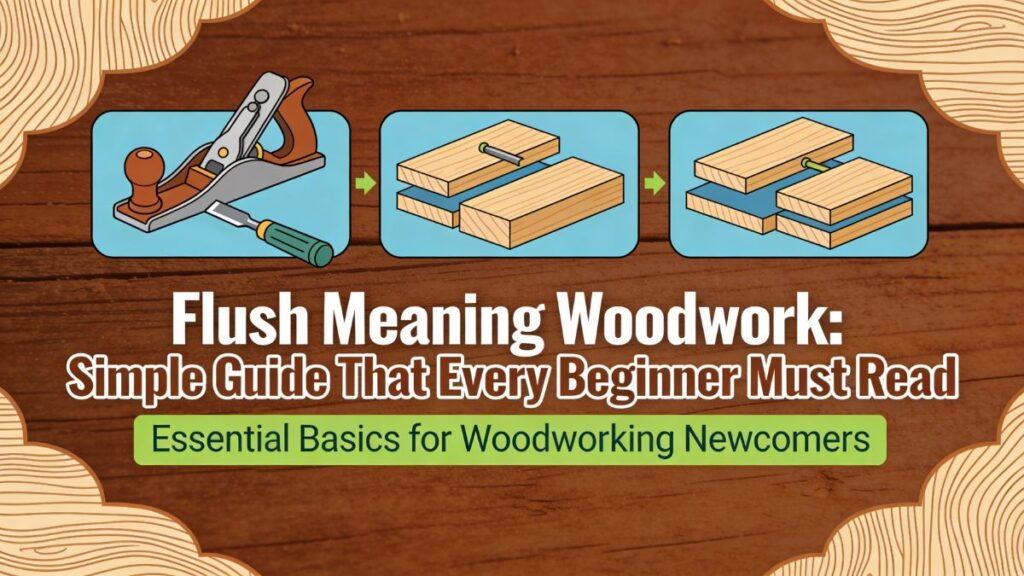

Ok so let me be honest with you guys. When I first started doing woodwork at home, I kept hearing this word “flush” everywhere. Youtube videos, reddit forums, even my freind who does carpentry was saying it. And I was like… what on earth does flush meaning woodwork actually refers to? Is it same flush like toilet flush? Haha no no, its something completly different.
So today I am going to explain everything about flush meaning woodwork in the most simple way possible. No fancy words. No confusing stuff. Just plain talk from one beginner to another. If you are just starting out with DIY wood projects and feeling confused about this term, trust me you are not alone. I was in same boat few years back.
What Does Flush Actually Mean in Woodworking?
Ok so here is the thing. When someone says two pieces of wood are “flush” it basicly means both surfaces are sitting at the same level. Like perfectly even. No bump sticking out. No gap between them. Think of it like this, when you put two books on a table and their top edges are at exact same height, thats flush.
In woodworking this is super important yaar. Because if your wood pieces are not flush, your project is gonna look weird. Like something is off but you cant tell what exactly. I remember making my first small shelf and one board was sitting little higher than the other one. It looked so bad and honestly it was wobbling also.
So when carpenters or woodworkers talk about flush surface meaning, they mean that smooth, even, no gap kind of finish where everything lines up nicely.
Why This Word Confused Me So Much
You know what the problem is? The word “flush” has like hundred different meanings in English. In slang, flush meaning slang is like having lots of money. “He is flush with cash” type thing. Then in plumbing its about cleaning pipes with water. And in printing, flush cut meaning in printing is about text alignment where lines start from same edge.
So when someone new like me heard “flush” in a woodworking video first time, my brain went everywhere except the right meaning. I think many of you also had this confusion na? Especially if English is not your first language like me.
But in woodwork its actually very straightforward once you get it. Two surfaces, same plane, no step up or step down between them. Thats it. Simple.
Flush vs Proud vs Shy: The Three Amigos
Ok so this is something most websites dont explain properly and I wish someone told me this earlier. In woodworking there are three words that go together.
Flush means both pieces are at same exact level.
Proud means one piece is sticking out a little above the other.
Shy means one piece is sitting a little below the other.When two adjoining surfaces are joined perfectly flat to each other they are flush. Otherwise one is ‘proud’ and the other ‘shy’.
See how simple this is? But nobody explains this in beginner videos. They just say “make it flush” and expect you to know everything. When I was building a small wooden stool for my balcony, the legs were proud by like 2mm and the whole thing was rocking on the floor. So I had to sand them down until they were flush with each other.
Flush Meaning in Construction: Is It Different?
Now some of you might wonder, ok this is woodwork but what about flush meaning in construction? Is it different thing?
Honestly no. The core idea is exactly the same.In the construction industry, the word ‘flush’ typically refers to two surfaces or components being aligned or even with each other, creating a smooth, seamless transition without any protrusions or gaps. If two materials or surfaces are flush, they are perfectly level or aligned.
Whether its wall panels, tiles on floor, or kitchen cabinets, the idea doesnt change. Everything should be at same height and same plane. The only difference is scale. In construction you are working with walls and floors and big stuff. In woodworking its smaller pieces of timber.
But for us DIY beginners, its good to know this because sometimes we do both right? Like I once installed a flush door in my workshop room and needed the frame to be flush with the wall. So the concept carries over from one thing to another.
What is a Flush Door Anyway?
Since I mentioned it, let me quickly tell about flush doors too. A flush door is basically a flat door. No raised panels, no fancy designs on surface. Just smooth and flat on both sides. Thats why its called flush because the whole surface is at one even level.
These doors are actually really popular for modern homes because they look clean and minimal. And you know what, they are cheaper also compared to panel doors. So if you are on a budget like most of us, flush doors are great option.
I installed two flush doors in my home and honestly they look much nicer than I expected. Very clean look.
Budget Tools You Need for Getting Flush Results
Ok now lets talk about the real stuff. How do you actually make things flush in your projects? You need some basic tools and dont worry, they are not expensive at all.
Sanding Block or Sandpaper: This is like your starting tool. When two pieces of wood are just a tiny bit uneven, some good sanding can bring them to same level. I use 120 grit for rough work and 220 grit for final smoothing. A basic sanding block costs like 3 to 5 dollars only.
Hand Plane: This is little bit more advanced but honestly a small block plane is amazing tool. You can shave off thin layers of wood until both surfaces are even. I got mine for around 15 dollars from a local store and its been really helpful. When you need to remove a little more material than sandpaper can handle, a block plane is your best buddy.
Flush Cut Saw: Now this one is specifically made for cutting things flush.Flush trim, or flush cut saws, are specially designed for flush trimming. What makes them different from regular saws is their tooth set or lack thereof. On most hand saws, the teeth angle out slightly from the blade. This is called the tooth set. But on flush cut saws, the teeth go straight out from the blade with zero set. This lets you saw with the blade flat against a reference surface without scratching it.
You can get a decent Japanese style flush cut saw for around 15 to 20 dollars on Amazon. Honestly its one of the best purchases I made for my small workshop.
Combination Square: To check if things are actually flush, you need some measuring tool. A combination square helps you verify that edges are at same level. Without this you are just guessing and trust me guessing doesnt work in woodwork.
Chisel: Sometimes you just need to pare away a tiny bit of extra wood. A sharp chisel can do wonders for getting a flush result especially when working on joints.
If you want to know more about essential tools and fixings, I wrote a detailed guide about woodworking fasteners that might help you.
My First Flush Joint Disaster (Real Story)
Let me tell you about my biggest mistake haha. So I was making a simple box from pine wood. Nothing fancy just a small storage box for keeping my tools. And I had to join four sides together with wood glue and dowels.
After glueing everything I noticed the dowels were sticking out from the surface. Like small bumps everywhere. I didnt know about flush cut saw at that time so I tried using a regular hand saw to cut them off. Big mistake. The regular saw teeth scratched the surface so badly. Like ugly scratch marks all over the box.
Then someone on Reddit told me about flush cut saws.The Flush Cut Saw is a specialized saw designed to neatly finish the surface and joints of wood. It is primarily used for cutting dowels and wooden pegs, and its teeth have no set, making it less likely to damage the surface. After getting one, my life changed. No more scratches, clean cuts, everything looking proffesional.
So ya, if you are doing any project with dowels or pegs, please get a flush cut saw. Dont make the same mistake like me.
How to Actually Make Two Surfaces Flush (Step by Step)
Alright so here is my simple method that I follow. Its not perfect but it works for me and maybe it will help you also.
Step 1: First join your wood pieces however you want. Glue, screws, dowels, whatever.
Step 2: Let everything dry completly. Dont rush this part. I usually wait overnight.
Step 3: If there are dowels or pegs poking out, use your flush cut saw to trim them close to the surface. Keep the blade flat against the wood while you pull it.
Step 4: After cutting, use your block plane to shave off any remaining tiny bumps. Go slow and take thin shavings only.
Step 5: Finally sand the whole area with progressively finer sandpaper. Start with 120 grit then go to 180 and finish with 220.
Step 6: Run your fingers across the surface. If you cant feel any bump or step, congratulations its flush now.
This whole process takes maybe 15 to 20 minutes for a small project. But the result makes your work look like ten times better. Trust me on this one.
Common Mistakes Beginners Make (I Made All of Them)
Let me save you some trouble by sharing mistakes I already did so you dont have to.
Rushing the measurement: I cant stress this enough. Measure everything twice or even three times before cutting. One wrong cut and your pieces will never sit flush properly.
Using wrong saw: As I told you regular saw will scratch your surface. Always use a flush cut saw for trimming dowels and joints. The cut flush meaning is literally about making a clean cut that sits even with the surface.
Skipping the sanding: I know sanding is boring yaar. But if you skip it your flush joint will still have tiny rough spots. Even 5 minutes of good sanding makes huge difference.
Not checking with a straight edge: Your eyes can trick you. Something might look flush but actually its not. Always verify with a straight edge or combination square.
Applying too much pressure on plane: When using a block plane many beginners push too hard and end up removing too much wood. Then the surface goes from proud to shy which is even worse. Light passes only.
Where Flush Matters Most in DIY Projects
You might think flush is only for fancy furniture makers but actually no. Even in simple home projects, flush surfaces are everywhere.
Building a bookshelf? The shelves need to be flush with the sides. Making a picture frame? All four corners should meet flush. Even something as basic as a wooden lamp base needs its parts flush for it to stand straight.
In fact I would say that understanding flush meaning woodwork is probably one of the most important basics you should learn. Its not glamorous or exciting but it makes the difference between something that looks homemade in a bad way versus something that looks homemade in a good way.
What People on Reddit Say About Flush in Woodwork
I spent quite some time reading flush meaning woodwork reddit discussions and honestly the woodworking community there is very helpful. Most experienced woodworkers say the same thing basically. Patience and the right tool are everything when it comes to getting flush surfaces.
One thing I noticed on forums is that many pros recommend leaving joints slightly proud on purpose and then trimming down to flush afterwards. The logic is simple. Its much easier to remove a tiny bit of extra material than to add material back. This was such a game changer for me when I learnt it.
Also many reddit users recomend putting tape on the surface around the area where you are cutting flush. This protects the wood from accidental scratches. Such a small tip but so useful.
Flush Cut Saw vs Regular Saw: Quick Comparison
I get this question a lot so let me just quickly clear it up.
A regular saw has teeth that are angled outwards on both sides. This is called the “set” and it makes the cut wider than the blade. Good for cutting through wood fast but terrible for flush trimming because those teeth will dig into and mark up your surface.
A flush cut saw has teeth with no set at all. They go straight out. So when you lay the blade flat on a surface and cut, it wont scratch the wood underneath. This is what makes it special for trimming dowels, plugs, and through tenons flush with the surface.
For you as a beginner, I would say get both. A regular saw for your normal cuts and a flush cut saw for finishing work. Together they probably cost under 30 dollars. Totally worth it.
Can You Get Flush Results on a Tight Budget?
Absolutely yes and this is something I really want to emphasize because I know many of us dont have big budgets for fancy tools. When I started, I had maybe 50 dollars total for all my tools. Here is what I did.
I bought a cheap sanding block, a pack of mixed sandpaper, one small chisel, and a basic flush cut saw. Thats it. With these four things I was able to get surprisingly good flush results on my early projects.
You dont need a 200 dollar router or expensive power tools to make things flush. Your hands, some patience, and basic hand tools can do amazing work. The whole point of learning DIY woodworking is to make things with what you have, not wait until you can afford everything.
Over time I slowly added more tools like a block plane and a combination square from Swanson. But those first few tools carried me through many projects.
Flush Surface Meaning in Different Contexts
Just to wrap up all the meanings so you have complete picture in one place.
Woodworking: Two wood pieces at same even level with no gap or bump.
Construction: Walls, tiles, cabinets, doors all sitting at same plane with surrounding surfaces.
Printing: Flush cut meaning in printing refers to text that is aligned to one edge with no indent. Also called flush left or flush right.
Slang: Flush meaning slang is having plenty of money. Like “feeling flush after payday.”
See how one word can mean so many things? But for us woodworkers the meaning is always about that clean, even, perfectly aligned finish.
Conclusion
So thats basically everything I know about flush meaning woodwork from my own experience as a DIY hobbyist. Its not a complicated concept at all but it took me some time to properly understand it and apply it in my projects. The most importent thing I can tell you is dont overthink it. Just remember, flush means even, same level, no bump, no gap. Thats all.
Get yourself a basic flush cut saw, a sanding block, and some patience. Start with small projects and practice making things flush. Before you know it, your work will start looking so much better and people will start asking “did you really make this yourself?”
FAQs
What does flush mean in woodworking?
Flush means two wood surfaces are perfectly even and at same level with each other, no bump or gap between them.
Is flush same as level?
Not exactly. Level means horizontal to the ground. Flush means two surfaces are even with each other, they can be flush but not level at same time.
What tool do I need to make things flush?
A flush cut saw, sanding block, and a sharp chisel are the basic tools. Block plane is also very usefull for this.
What is a flush door?
A flush door is a simple flat door with smooth surface on both sides, no raised panels or decorative carvings on it.
Why do woodworkers leave joints proud first?
Because its easier to trim down extra material to make it flush than to add material back if you cut too much.


Pingback: Best Woodwork Machine for Beginners on a Tight Budget